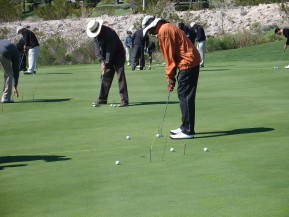
Moe Norman

Heard It a Thousand Times … The Grip…

By Tim Graves, PGA

From: jay@log….
Subject: The GRIP!
To: Tim Graves <timg@gravesgolf.com>

I’ve heard it more than a thousand times…

I finally figured out just how the grip ‘feels’.  And now I am able to  confirm that I have the grip correct.

Positioning on the handle…

Correct overlapping of the trail hand little finger…

Lead hand thumb comfortably in the crease of the palm pad of the trail hand…

I was amazed when I finally ‘felt’ the proper fit of my hands on the club handle.  I always fidgeted with my grip before coming to address—and thought it was correct.  But when I accidentally did it right, I ‘felt’ it immediately.

After all the hands-on instruction, I never really got it.  And I just sort of stumbled into it while fidgeting.  The result was immediate transformation and much improved direction, distance and accuracy with all clubs—especially my driver.

Thanks for harping on the importance of the Grip.

Merry Christmas to You and Yours!

Jay C. / Pie Town, NM

*****
Additional Grip Help / Instruction: Go to: https://gravesgolf.com/product-support/

Click on GGA Grips (2 Instruction Videos about proper grip / hold of club)
Smooth Authority

By Tim Graves, PGA

Mark W. (East Saint Louis, MO)

To: Timg@Gravesgolf.com

Hey Tim;

I just wanted to say thank-you and to share my experience playing yesterday due to some freakishly warm weather in St. Louis.

This month I have been working on my putting, chipping and pitching (into a tarp) in the basement for a few minutes daily and tracking the time spent. It’s amazing how spending 7 to 12 minutes a day per discipline can add up – so far this month I’ve practiced my putting stroke alone for 3 hours plus (23 of 27 days). I have incorporated your teachings on ball position, shaft lean and hands down the line and continue to work to ingrain them.

Your tips during the FF <Fast Forward> presentation – specifically the single trail hand drill that Tiger used, and the short backstroke to promote acceleration – were golden. Yesterday – the first real round in over 6 weeks – I had 30 total putts with no three putts. What’s more – I had several 4-6 footers that due to your acceleration drill went in the hole with smooth authority!

Thank-you for all that you do to share your insights – very grateful for you and the GG team.

Mark

Enjoy your day – “The Best Is Yet To Come”

Fast Forward Information:

http://gravesgolf.com/fast

Mental Game Skills Must Be Cultivated

By Paul Monahan, Graves Golf Mental Game Coach

What are you doing to cultivate productive mental game skills in your golf game?

Coaches don’t really DO anything. If we are doing our job right, we engage with our clients about what they really want…and then help them to gain the insights and passion necessary to take meaningful action toward their goals.

But that action is up to them. The client. It’s not up to us. If the client doesn’t do anything with this information, nothing changes for them.

Last week’s story from Bob about winning his club’s opening  tournament is a great reminder that you must be intentional about applying mental game strategies and concepts.That you must have to have an on-purpose strategy and action plan to cultivate these skills…the same the way you build your short-game or putting skills.

In a phone conversation with him earlier this week, Bob told me that he hadn’t really given a lot of thought to building a mental game strategy. Though, he had spent a considerable amount of time working on Single Plane Swing mechanics the past two years – attending a number of schools, working with GGA coaches through video and other programs, and dedicating numerous hours on the driving range.

But that changed for Bob when he watched the webinar that Tim Graves and I did on the Alert Attitude of Indifference…and it piqued his interest. More than that, it inspired him to act. As a result, he committed to cultivating the key mental game concepts Tim and I talked about…and to making them a part of his playing strategy.

For example, he committed to playing faster. He modified his own pre-shot routine so that he could hit shots inside the “play box” within 5-7 seconds. This would prevent the kind of over-analysis and over-thinking that shows up when we hover over our shots too long. (He believes that he hit a lot more high-quality shots as a result!)

And he decided that, considering the course conditions (very wet) and that they were playing lift, clean and place, he would do whatever it took to be in the fairway. So while other players were bombing it into the rough, Bob played conservatively off the tee and hit lots of shots from the fairway that day. (His discipline to creating a strategy and sticking to it was key.)

He also tuned-in to and monitored is own energy dynamics during his round– and was able to stay positive on the occasions when things didn’t turn out perfect: when he hit it into the rough on the playoff hole, he took notice of the situation, reminded himself that he had the option to stay positive, hit a clean recovery shot into the fairway, and was on the green on the next shot. (His opponent was not able to stay calm and measured when encountering challenges on that hole – and it cost him the tournament.)

It will always be the case that practice and skill development are an important part this game we play. But being intentional about cultivating your mental game skills – how you show up, how you respond to the game as it comes at you –  is also a critical element of lowering your scores.

-Paul

(If you want to really learn how to cultivate productive mental game skills, join us at our two-day Mental Game / Alert Attitude of Indifference School in the near future.)

Winter Training – Get Ahead of Your Buddies

By: Tim Graves, PGA

It’s the off-season for golf. Your golf buddies are eating turkey and getting fat. I can’t think of a better time to get the edge on them. So get off the couch and let’s get practicing!

Students often ask how to improve their games in the off-season. And most of you who have participated in our instruction know that we strongly promote many types of practice away from the driving range – in your own home, even while you watch football.

We have quite a few options for working on your game in the winter. Here are some ideas:

1) Always work on flexibility strength and fitness. Remember, you are an athlete if you play golf. Train like an athlete. See our Single Plane On Demand App and in particular our “Flexibility and Exercise Video” for more information. Also “Improve your Move” Video is great for indoor training.

2) Practice positions in front of a mirror – all of the positions of the swing. Training on creating new habits / new positions in front of the mirror. Remember, the slower you do it, the faster you will get it. Use the Single Plane Position Trainer to work on positions in front of the mirror. Work with a online coach to make sure you are training correct and working on habits you need to improve.

3) Find (or build) an indoor studio where you can hit balls into net. Use video to look at your swing and compare to Moe and model the Single Plane Swing. Indoor – Net practice is great for making changes in the winter and with a net you will still be focusing on swing positions rather than ball flight. A VERY good thing.

4) Practice your short game inside, in particular your putting stroke (using Excalibur Trainer) and chipping stroke. Remember, short game is just smaller version of full swing. Working on short game will not only help you scoring part of game, but can also help your full swing (aka – “Two Birds”).

5) Work on your mental game over the winter. Green / Red and Grey Zones (Preshot, In-Shot and Post Shot routines). Work on improving your practice regimens, work on improving your mental game on and off the course.

I can’t think of a better time to work on your game: swing, flexibility, short game and mental game over the winter. You are not rushed over the winter, anything you improve will get you ahead of those who are not practicing and you will not be working hard in early spring trying to get back to where you were when season ended last year…

We can help.

STRONGLY recommend looking into our Winter Fast Forward Training Program. Includes full swing, short game, fitness and flexibility and mental game training / work over the winter. A three month program starting in middle of December that will guarantee improvement and getting you ahead of all those “sitting” over the winter.

More information about Winter Fast Forward Training Program: CLICK HERE

Or email me at timg@gravesgolf.com

I will be happy to get you information about our Winter Fast Forward Training Program.

“Mind Boggling” – Holy Crap / Brighten Your Day Email Part 2

By Tim Graves, PGA

From: D A JENSON <jenson*****>
Date: Mon, Dec 8, 2025 at 8:40 AM
Subject: Follow-up
To: Tim Graves <timg@gravesgolf.com>

Hey Tim, 

This is Dean Jenson again.  I just got the email with your video about my email.  I was chuckling when you described what I was likely doing in my swing.   You nailed everything, of course. 

Just to fill in some blanks, I had the body damage mentioned from my sports activities earlier in my life.  Boys will be boys.

I spent one winter looking at different golf swings and settled on the single plane because of the reduced strain on the back and lead knee.    

My ACL damage was significant.  If I slipped a little shoveling snow, I would be down on the ground instantly.  I had to be very conscious of foot placement. I got the ACL replacement when pro athletes started returning to their sport after having the procedure done.  The problem for golf was 15 years of conscious and subconscious knee protection.  Correct lead knee movement and trail hip motion took years to override the self-protection mechanisms. 

I am not going to get into my shoulder and arm issues.  However, after talking with other students at your schools that I have been to, I feel relatively unscathed.  I suspect overcoming self-protection mechanisms might be slowing down other students’ learning processes as well.  I first had to slowly hit each position and hold it and tell myself that it was a safe position for me to be in. I had to repeat those slow movements a lot before I could speed up my swing.  Your comments about the 25, 50, 75 then full swing are great practice methods for the swing.   But they were also very helpful for tip toing in to find out my body parts could perform the movements safely. 

I decided last Thanksgiving that bike riding indoors and outdoors would be my main source of exercise for life.  Watching pro bike races got me interested in training.  Training harder got me into the pro rider’s health habits.  That got me and my wife into better nutrition, which was already good thanks to my wife.   I started getting into joint mobility and stretching after seeing and listening to you and Chris.  My wife made stretching a little competitive as she would ask me if I could do some of her Yoga poses.  I couldn’t, and my hips would actually cramp up just from sitting on the floor and spreading my legs out.   That was freaky.   I have been working on hip flexibility regularly for the last year and will continue whole body mobility as long as I breathe.   I am conscious of and work towards keeping full shoulder range of motion.  The golf swing itself helps with that.  The golf exercises from Chris, of course, are tremendous.  I may not get stronger, but flexibility will help maintain my golf swing’s range of motion.  It appears to me that range of motion is most important for the proper swing positions to take place and create the effortless power you talk about regularly.    

In the last month I have begun to feel effortless power.   I actually feel I need to slow the swing down.  I was always trying to swing hard to make up for a less than perfect swing.   Maybe it is not slowing things down but just using less tight muscled-up force.  I have reached a connectedness in the swing where I can feel I am hitting the ball hard; it sounds different as well.   The ease of the swing now makes me feel I could easily do 36 holes a day if I wanted to.   It is just mind boggling seeing the changes in the last 2 months.  

This is getting a little long again, sorry.  Apparently, I don’t do short emails.    

Thanks Again,

Dean Jenson 

Mastery Orientation

By Paul Monahan, Graves Golf Mental Game Coach

GGA Mental Game Coach

Your brain is amazing.

It regulates your body process, allows you to analyze and interpret external stimuli and is the source of the very consciousness that allows you to read this sentence.

And it is also an incredible survival tool.

The brain has a very powerful (but primitive) threat response system designed to keep you alive. Great when you need to run from a tiger (as you may have needed to 50,000 years ago), but not so great when you want to perform at your best in a competitive situation (like the Spring member-guest against your buddies.)

Your brain’s threat response system is always monitoring your external environment to determine if your safety is in jeopardy, much like aa software program running silently in the background. You probably aren’t even aware of it.

The challenge with this system is that it is not smart enough to know the difference between a saber-toothed tiger running toward you (which could ACTUALLY harm you) and a slippery downhill 10-footer on the eighteenth hole to tie your match.

In both cases, your brain goes into threat response because it has assessed that you might lose something very important to you. It signals to your body that you are in danger.

The problem? On the golf course, this response has physical and mental implications. Sweaty palms impact your ability to hold the putter properly. Nervous, shaking hands affect your ability to move the putter as you would like to. And clouded judgment can impact the kind of decision-making that keeps you in your process.

So what to do?

I believe that we can be successful more consistently in nearly any performance context when we do certain things to prevent the brain’s threat response from activating.

I coach my clients on the distinction between operating from a Mastery Orientation versus operating from an Outcome Orientation. And I teach them how to adopt a Mastery Orientation whenever stepping into any kind of performance arena.

The primary difference between the two operating orientations is this: people who operate a Mastery Orientation are concerned with elevating their competence. People who operate from an Outcome Orientation are concerned with proving their competence.

Because of this, a golfer with a Mastery Orientation has a distinct performance advantage. They are more likely to stay connected to all their skills and abilities. And they can execute at a high level and do things like:

  • tune into their surroundings in productive ways
  • stick to their game plan and make clear decisions
  • stay in the present moment and execute their process
  • feel the putter move freely
  • be playful and PLAY the game

This is because they are not wrapped up in results. To them, outcomes are important, but only insomuch as they (the outcomes) reflect where they (the golfer) are on their own path to mastery.

They know deep down that the WORST that can happen is that they will learn something: about their game, their capacity for resilience, their ability to compete in certain conditions…etc. And because they hold this knowledge, their brain’s primitive threat response is not activated as easily.

When they hit wayward shots, they see those shots in the context of their overall goals in golf – and not as defining moments in that particular competition, nor even how they define their own self-worth.

In a way, golfers who operate from a Mastery Orientation have written a story for themselves about what their experiences on the golf course mean to them. And they access that story each time they play.

For them, golf is not (entirely) about winning or losing, but rather about growing in their mastery of the game. Each shot – no matter the stakes – is an opportunity to learn and improve, not a challenge.

The result? They play better. They score better. And typically enjoy themselves more.

On the other hand, the golfer who operates from an Outcome Orientation is typically in for a much more emotionally-charged ride on the course. Why? Because their ego is heavily involved in how they see each shot. (Remember, they are trying to PROVE their competence, not grow it.)

When they stand at the first tee, they experience anxiety because they are trying to show the world the fruits of all their hard work on the range. (We call this pressure.)

And when they have to face that slippery downhill 10-footer, the dominant thoughts are not about what they could gain, but rather about what they might lose. They experience what my colleague and NHL hockey prospect coach Walter Aguilar calls horizontal thinking: they “move horizontally” in their thinking to the future, imagining how awful it would be to miss the putt and to lose their credibility with their friends and/or competitors.

As a result, they begin to lose access to their high-level cognitive functioning, as well as the physical skills and abilities they possessed prior to starting the round. And of course, this can start a kind of performance death spiral that is very difficult to pull out of.

The good news is that you have options. You can choose the mental and emotional stance from which to operate when you play. You can choose the orientation you want to adopt when playing golf.

xI hope you choose a Mastery Orientation.

LEARN

THE

SWING

Join 1M+ Subscribers to get your FREE Video Quick Start Guide that reveals how to hit the ball farther and straighter more consistently from now on…

START YOUR NEW GOLF SWING